 AFA Connect
Why the Air Force Is Rushing a $10 Million Reaper Successor
Combat attrition has turned the Massed Modular Aircraft from a long-range replacement idea into a 2029 acquisition test.
By Joy Glip ·
Original AFA Connect reporting. Facts are attributed to the public records and reporting listed below. Report a factual error.
Sources and records
- Air Force shapes requirements for a new era of uncrewed airpower — U.S. Air Force
- Air Force Launches New Low-Cost Drone Program After Heavy MQ-9 Losses in Iran — Air & Space Forces Magazine
- US Air Force speeds Reaper successor timeline after Iran losses — Defense News
- DIU seeks cheaper drones to carry out Reaper missions — Breaking Defense
- Air Force to begin concept refinement of MQ-9 replacement by end of year — DefenseScoop
- MQ-9 Reaper — U.S. Navy via DVIDS
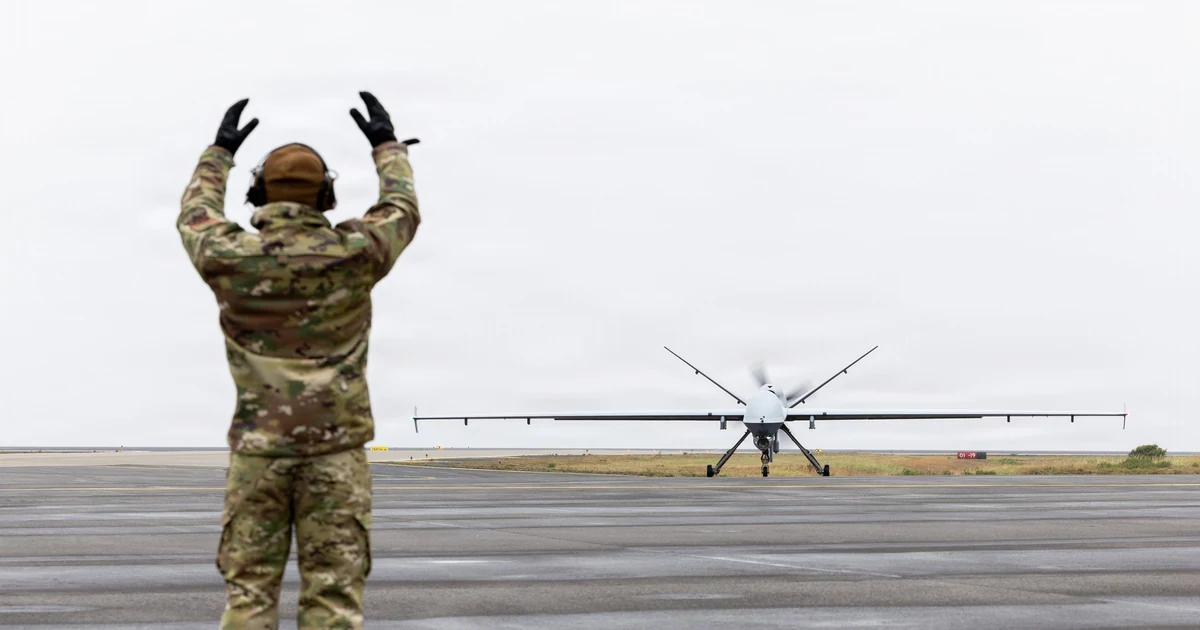
Image: An Air Force ground crew member signals to an MQ-9 Reaper during Northern Viking 26 at Keflavik Air Base, Iceland, on Aug. 21, 2026. U.S. Navy photo by Petty Officer 1st Class Conor Martin.
The Air Force is no longer treating its next long-endurance uncrewed aircraft as a distant replacement problem. After combat attrition exposed how difficult and expensive it is to replenish MQ-9A Reapers, service leaders are pushing the Massed Modular Aircraft program toward a prototype in about a year and fielding at scale as soon as 2029.
The shift is bigger than a schedule change. It is a test of whether the Air Force can replace one highly capable aircraft with a cheaper, modular family that commanders can risk in defended airspace without surrendering the surveillance, communications and strike capacity that made the Reaper indispensable.
What changed since July
The Air Force announced in July that it was working with the Defense Innovation Unit to shape the future of the MQ-9 fleet. The initial Massed Modular Aircraft outline called for a full-scale prototype within 21 months of contract award and 20 mission-ready aircraft by fiscal 2031, according to the July solicitation described by Breaking Defense.
At a Sept. 3 Pentagon briefing, officials described a sharper timetable. DIU military deputy Maj. Gen. Joseph Kunkel said the team would try to prototype within one year of a contract and field at scale within three years—as early as 2029—Air & Space Forces Magazine reported. Lt. Gen. Christopher Niemi, the Air Force’s chief modernization officer, said Secretary Troy Meink had directed the team to move faster.
Niemi also connected that urgency to the rate at which MQ-9s have been lost during operations against Iran and Iranian-backed forces. Air & Space Forces Magazine reported at least 45 losses since the Iran war began; the Pentagon did not publish an updated fleet count at the briefing. Defense News separately reported that May Senate testimony placed the fleet near 135 aircraft, below the Air Force’s stated 189-aircraft floor.
The $10 million target changes the design trade
The reported target is about $10 million per aircraft. That is a planning goal—not an awarded price, signed production contract or guarantee. DefenseScoop reported in July that the service planned to use multiple vendors during concept refinement to understand what industry could provide and build a budget from those offers.
That price ceiling forces a different answer from simply buying a more capable Reaper. The Air Force wants an aircraft that can perform missions the MQ-9A handles today, carry different payloads, operate over long distances and be produced in enough numbers that commanders can accept losses. Modularity matters because the same basic air vehicle could be configured for sensing, communications, targeting or weapons rather than carrying every capability on every flight.
The trade is unavoidable: endurance, payload, survivability, communications and autonomy all compete for cost and weight. A $10 million target may produce a useful aircraft only if the service resists requirements growth. If each new mission demands another exquisite sensor, defensive system or certification step, the program can recreate the cost structure it is meant to escape.
Speed is now the first acquisition test
Bringing the schedule forward by roughly two years would be consequential, but a prototype flight is not the same as an operational squadron. The program still has to select vendors, refine requirements, integrate mission systems, test communications and autonomy, prove maintainability and secure production capacity. The 2029 objective should therefore be read as a fielding target rather than a completed outcome.
The near-term risk is a gap between a shrinking Reaper inventory and a successor that remains on paper. General Atomics ended MQ-9A production in 2025, Defense News reported, and senior Air Force officials have said that buying a large fleet of the more expensive MQ-9B is not a simple substitute. That puts unusual pressure on MMA’s concept-refinement and prototype phases: they must learn quickly without turning urgency into optimistic accounting.
The Air Force’s decision signals a broader lesson from recent combat. Attritable aircraft are not useful merely because they are cheaper to lose. They matter only when industry can replace them faster than operations consume them and when commanders can combine enough of them to generate persistent effects. MMA’s real measure will not be its first flight. It will be whether the service can keep the design affordable, build it at scale and deliver mission-ready aircraft before the Reaper fleet loses too much capacity.
Featured image: An Air Force ground crew member signals to an MQ-9 Reaper during Northern Viking 26 at Keflavik Air Base, Iceland, on Aug. 21, 2026. U.S. Navy photo by Petty Officer 1st Class Conor Martin via DVIDS. Public domain; use does not imply Department of War endorsement.
Have a correction or additional public documentation? Contact AFAConnect.