 AFA Connect
Why New F-16s Would Be a Capacity Decision, Not a Technology Reset
The Air Force is studying whether new-build F-16s could address fighter-capacity needs as it develops its fiscal 2028 budget plan.
By Joy Glip ·
Original AFA Connect reporting. Facts are attributed to the public records and reporting listed below. Report a factual error.
Sources and records
- Air Force eyes new-build F-16s to boost fighter force — Air & Space Forces Magazine
- DVIDS image 8876001 — Defense Visual Information Distribution Service
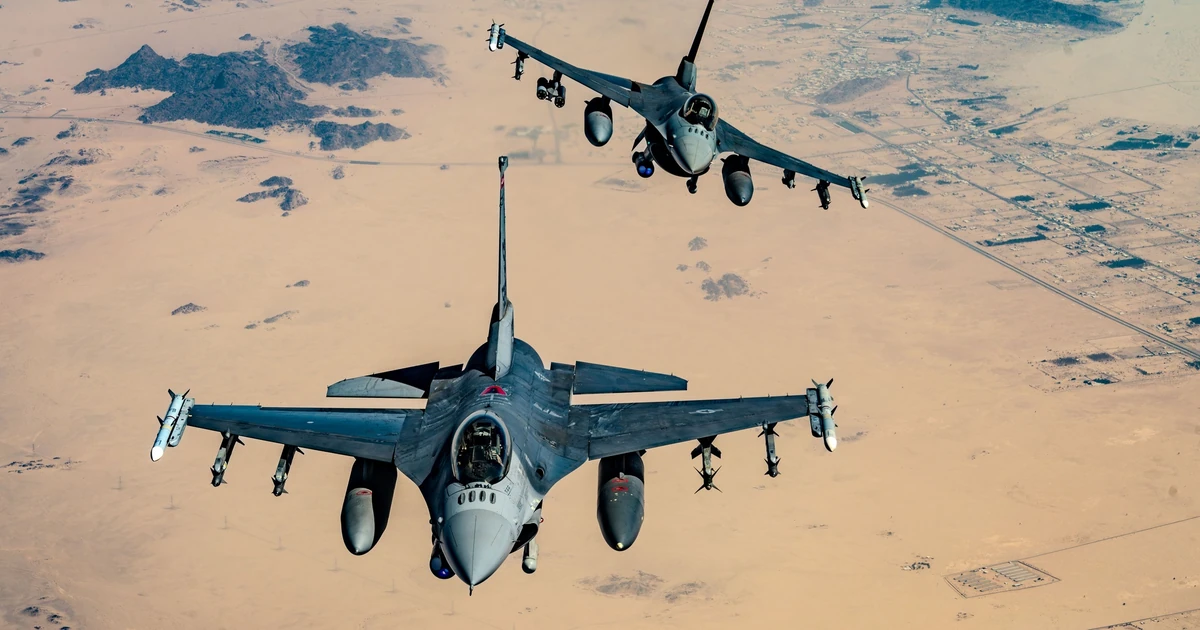
Image: Two U.S. Air Force F-16 Fighting Falcons patrol the U.S. Central Command area of responsibility on Feb. 11, 2025. This archival image provides operational context and does not depict aircraft tied to the reported acquisition review. U.S. Air Force photo by Staff Sgt. Jackson Manske. The 1200 × 630 presentation crop removes 140 pixels from the top and 141 pixels from the bottom of the 2000 × 1331 source frame; it adds or alters no objects within the retained crop.
WASHINGTON — The Air Force is considering whether new-build F-16s could help fill fighter-capacity shortfalls as it develops the fiscal 2028 budget and its accompanying five-year plan. The review is preliminary: the service says it has not yet defined the mission requirement or even the full range of options.
Air & Space Forces Magazine reported the deliberations Sept. 16, citing multiple people familiar with them. In a written response, an Air Force spokesperson told the publication that the department is in the initial phase of analyzing options for the next Future Years Defense Program.
That distinction matters. A planning option can test affordability, factory capacity and force structure without becoming a program of record. Until the service defines a requirement, submits a budget and Congress authorizes and appropriates money, a possible F-16 purchase remains exactly that: possible.
A capacity proposal, not a verdict on the fighter fleet
The reported discussion points to a practical force-structure problem: how to maintain enough combat aircraft while older fighters age, newer programs scale and operational units absorb transitions. Capacity is measured not only by the sophistication of one platform, but also by how many equipped, crewed and available squadrons the service can sustain.
The Air Force has 826 F-16s, including 484 in the active-duty force, according to the magazine. It reported that the aircraft average 34 years old and that the newest U.S. examples have been flying since 2005. Those figures help explain why a service-life discussion can become a production discussion: extending existing airframes and adding newly built ones solve different problems.
The magazine also reported that Air Force officials may discuss a more capable aircraft informally described by people familiar with the issue as an “F-16G.” That label does not establish an approved designation or configuration. The service's own response was narrower: precise mission requirements and possible solutions have not been defined.
Why an active production line changes the option set
The magazine reported that the company moved Block 70 production from Fort Worth, Texas, to Greenville, South Carolina, in 2019 and is building aircraft for international customers.
An active line gives planners an option that would not require recreating a long-closed production system. It does not guarantee immediate U.S. deliveries. Existing foreign commitments, suppliers, engine availability, mission-system integration and workforce capacity would all affect timing.
The magazine drew a parallel to the Air Force's F-15EX purchase after a long gap in U.S. orders and reported that capacity constraints limit how many F-35As and F-15EXs their manufacturers can produce. That makes the new-build F-16 question less about inventing another fighter and more about whether an established design and current factory could provide useful aircraft on a relevant timeline.
The tests that should decide the issue
Before a proposal reaches Congress, the Air Force would need to answer at least four questions.
- Mission: Which operational demands and squadron tasks require the additional aircraft?
- Delivery: How quickly could U.S.-configured jets arrive without displacing committed international production?
- People and readiness: Where would pilots, maintainers, munitions and operating funds come from?
- Opportunity cost: Which other readiness, weapons, upgrade or aircraft priorities would compete for the same resources?
Those tests would expose whether a buy is a true bridge or a permanent force-structure choice. A bridge has a defined gap, an end state and a transition plan. Without those boundaries, a capacity purchase can become another long-term modernization and sustainment obligation.
The production question also reaches beyond the airframe. The magazine noted that Pratt & Whitney and GE Aerospace make F-16 engines and that Northrop Grumman is developing electronic-warfare and targeting-pod upgrades for existing F-16s. Any new configuration would therefore depend on a wider supplier and integration network, not only Lockheed Martin's final assembly line.
The responsible reading today is not that the Air Force has chosen a new F-16. It is that planners are examining whether a familiar fighter and an active production base could add capacity — while the service still has to define the mission, compare alternatives and show what the choice would cost.