 AFA Connect
What the Air Force’s Human-AI Battle Test Proved—and What It Didn’t
The Air Force’s latest DASH test showed a modular path for human-AI battle management, but public results stop short of proving operational readiness.
By Joy Glip ·
Original AFA Connect reporting. Facts are attributed to the public records and reporting listed below. Report a factual error.
Sources and records
- DAF Accelerates Joint C2 with AI, Space Force Integration in Latest DASH Experiment — Defense Visual Information Distribution Service / Air Force Research Laboratory
- Air Force Puts Human-AI Teaming to the Test in C2 Experiment — Air & Space Forces Magazine
- DAF Accelerates Joint C2 with AI, Space Force Integration in Latest DASH Experiment [Image 7 of 22] — Defense Visual Information Distribution Service / U.S. Air Force
Image: U.S. Air Force photo by Debora Henley via DVIDS (public domain)
The Department of the Air Force’s latest command-and-control experiment put a U.S. Space Force-led crew, Air Force battle managers and industry software developers into the same two-week test. The strongest result was not a claim that artificial intelligence can replace a battle manager. It was evidence that the department can connect competing software tools through a government-owned interface and evaluate them alongside operators.
That distinction matters. The official Decision Advantage Sprint for Human-Machine Teaming release says the event gathered process metrics, human-factors analysis and operator feedback. It does not publish the numerical results needed to compare decision speed, accuracy or workload, nor does it announce a production decision or a fielding date.
What the experiment actually established
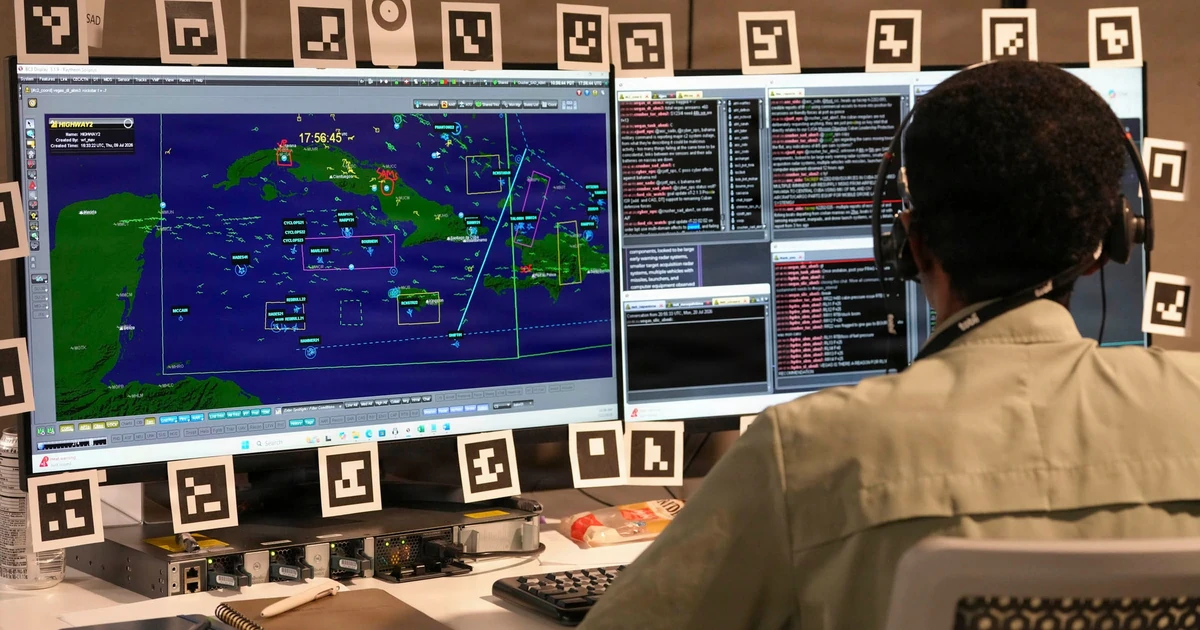
The event took place at the 805th Combat Training Squadron’s Shadow Operations Center-Nellis in Nevada. An integrated crew led by a Guardian worked through high-tempo scenarios with Air Force battle managers while developers observed how their tools affected the decision process.
The technical center of the test was an Air Force Research Laboratory-developed “orchestrator.” Officials describe it as a government-owned software interface that allowed multiple, competing industry applications to operate in a modular test environment. That is a meaningful acquisition result: a common interface can make it easier to compare tools and replace a weak component without rebuilding an entire vendor-controlled system.
The test also connected software assessment to the operators using it. According to the official account, AFRL software measured process execution during baseline runs and runs with vendor tools, allowing developers and battle managers to see feedback during the event. Human-performance researchers separately examined how the crew handled a large flow of data and time pressure.
The joint crew is more than a staffing detail
Air & Space Forces Magazine reported that the July 13-24 event was the fourth DASH iteration and the first in which a Guardian led the command-and-control team. Space operators brought simulated space-domain-awareness and electromagnetic-warfare parameters into a broader battle-management environment.
That arrangement tested whether a shared objective and common tools could bridge different service specialties. It did not erase those specialties. Space and air operators still bring different authorities, sensors and operational context. The practical value is in giving them a common technical layer without pretending that one domain’s workflow automatically fits another.
What remains unproven
The public record supports three narrow conclusions: the department assembled a cross-service operational crew; it connected multiple applications through a government-owned interface; and it collected technical and human-performance feedback in a demanding laboratory scenario.
It does not establish how much faster or more accurate the crew became, how the tools performed against a defined benchmark, or whether the architecture can sustain the security, reliability and scale required on operational classified networks. Officials say the framework was designed to move validated capabilities toward those networks, which describes the transition goal—not a completed fielding result.
The same caution applies to the phrase “human-machine teaming.” In this experiment, AI was used to process data and support people making decisions. The available evidence does not show autonomous authority over lethal decisions, and the department’s account repeatedly centers the operator rather than the software.
The acquisition test may be the enduring result
DASH combines experimentation with a buying strategy: government control of the integrating interface, repeated opportunities for competing applications, and direct operator feedback before a tool is pushed further into the force. If the department can preserve that modularity through security certification and deployment, it could reduce the lock-in and long integration cycles that have complicated past command-and-control modernization.
That “if” is the next test. Future evidence should include comparable performance measures, clear transition milestones and proof that the modular design still works on operational networks. Until then, the latest DASH event is best understood as a credible integration and acquisition milestone—not proof that an AI-enabled battle-management system is ready for combat.
Image: Airman participating in the Decision Advantage Sprint for Human-Machine Teaming in Las Vegas. U.S. Air Force photo by Debora Henley via DVIDS (public domain). The appearance of U.S. Department of War (DoW) visual information does not imply or constitute DoW endorsement.