 AFA Connect
What the fourth Tranche 1 launch means for SDA’s military data network
SDA has launched 84 Tranche 1 data-transport satellites across four missions. Here is why deployment is a milestone—not proof of an operational network.
By Joy Glip ·
Original AFA Connect reporting. Facts are attributed to the public records and reporting listed below. Report a factual error.
Sources and records
- SpaceX launches 21 military data-relay satellites on Falcon 9 rocket — Space.com
- Space Development Agency Successfully Completes Third Launch of Tranche 1 Satellites — Space Development Agency
- Tranche 1 Fact Sheet — Space Development Agency
- Vandenberg Launches SDA T1TL-C — Defense Visual Information Distribution Service / U.S. Space Force
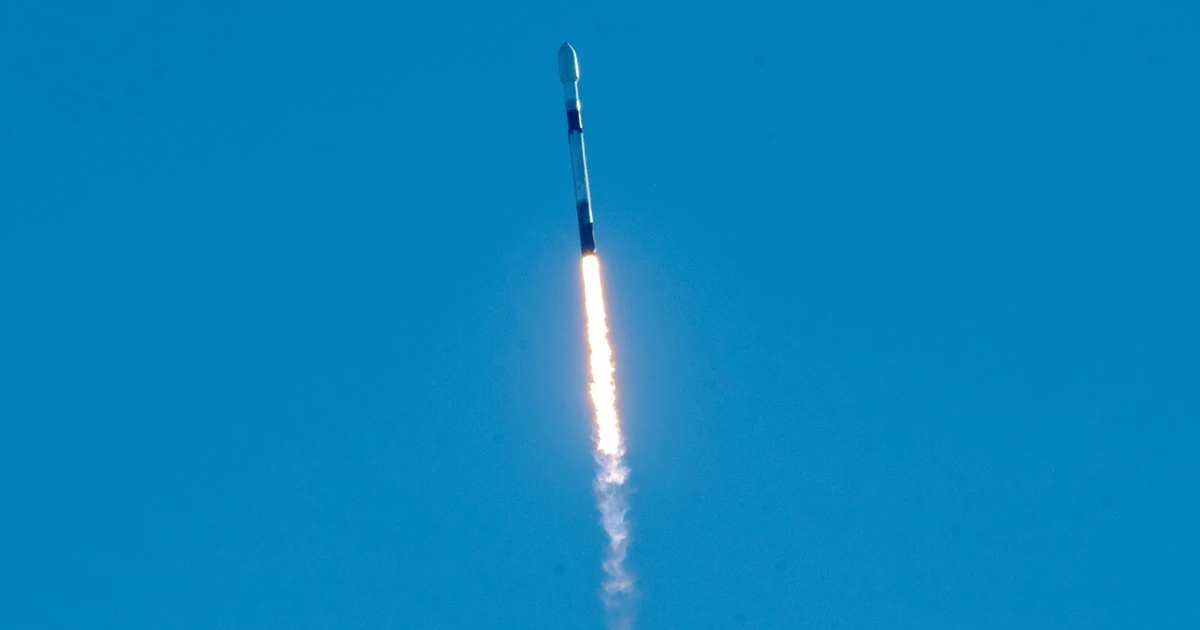
Image: Context image: U.S. Space Force photo by Airman 1st Class Ian Hawkes via DVIDS; depicts T1TL-C, not the Oct. 10, 2026 launch
A SpaceX Falcon 9 launched 21 Space Development Agency data-transport satellites from Vandenberg Space Force Base on Oct. 10, completing the fourth 21-spacecraft launch in the agency’s Tranche 1 Transport Layer campaign. Space.com’s launch report identifies it as the fourth of nine Tranche 1 launches and says the rocket carried 21 SDA data-transport satellites to orbit from Vandenberg. Orbit insertion is not the same as operational acceptance.
The clean headline number is 84 Transport Layer spacecraft launched across four missions. The more important distinction is what that number does—and does not—prove. It marks a substantial expansion of hardware in orbit. It does not, by itself, establish that 84 satellites have completed checkout, joined a functioning mesh, connected to operational ground systems and users, or been accepted for military service.
Context image: A Falcon 9 launches the earlier T1TL-C mission from Vandenberg Space Force Base on Oct. 15, 2025. U.S. Space Force photo by Airman 1st Class Ian Hawkes via DVIDS. The image does not depict the Oct. 10, 2026 launch.
Why 84 is a milestone, not the finish line
The Space Development Agency is building the Proliferated Warfighter Space Architecture as a large low-Earth-orbit network rather than a small collection of exquisite satellites. The design depends on numbers, distribution and connections: many spacecraft, optical links between them, ground entry points, operations centers and tactical users that can move data through the system.
SDA’s official account of the third Tranche 1 launch said the first three 21-satellite Transport Layer missions had placed 63 spacecraft in orbit. Adding the 21 reported on the fourth launch yields 84 launched Transport Layer spacecraft. That arithmetic is useful for tracking physical deployment, but it is not an operational-readiness score.
After separation from the launch vehicle, a constellation still has to move through spacecraft checkout and network integration. Optical crosslinks have to work across the mesh. Ground entry points and the two Space Operations Centers described by SDA have to support the constellation. Data services then have to reach military users in a form that can be employed reliably. Those are system-level milestones, and a launch webcast cannot demonstrate all of them.
Where the fourth launch fits in the larger plan
SDA’s published Tranche 1 plan calls for 154 operational spacecraft: 126 in the Transport Layer and 28 in the Tracking Layer. The agency also describes four additional missile-defense demonstration spacecraft. The Transport Layer is intended to carry low-latency tactical data; the Tracking Layer is intended to support missile warning and tracking. The architecture relies on those layers and the ground segment working together rather than on any single launch.
The official third-launch release said Tranche 1 will provide initial warfighting capability beginning in 2027. The agency’s Tranche 1 fact sheet describes intended capabilities including regional persistence for Link 16, missile warning and tracking, and beyond-line-of-sight targeting. Those remain program objectives, not capabilities that can be inferred solely from the number of spacecraft placed in orbit.
For that reason, the fourth launch matters in two different ways. Industrially, it shows the program continuing to place spacecraft in orbit in repeatable 21-satellite groups. Operationally, it moves the architecture closer to the density needed for persistent service. But the second conclusion remains conditional on the less visible integration work that follows launch.
What to watch next
The next meaningful public indicators are not only additional liftoffs. They include official confirmation of spacecraft checkout, demonstrations that connect the orbital mesh to ground and tactical users, progress across the Tracking Layer, and a clear statement that an increment has entered operational service.
That distinction protects against two opposite mistakes. Counting only operational declarations would understate the significance of placing 84 data-transport spacecraft in orbit. Treating every deployment as fielded capability would overstate what a launch proves. The most accurate reading sits between them: the fourth launch is a major deployment milestone inside a larger integration campaign whose military value depends on the network working end to end.