 AFA Connect
What the F-15EX Lot 7 Award Changes for Fighter Capacity
The 22-aircraft F-15EX Lot 7 award protects production capacity and raises the contracted total to 120, while deliveries and fielding remain separate milestones.
By Joy Glip ·
Original AFA Connect reporting. Facts are attributed to the public records and reporting listed below. Report a factual error.
Sources and records
- DAF awards F-15EX Lot 7 contract for 22 aircraft — U.S. Air Force
- Boeing Secures Order for 22 More F-15EX Fighters — Boeing
- Air Force Inks Deal for 22 More Boeing F-15EX Fighters — Air & Space Forces Magazine
- F-15EX and F-15E air power soars at Kadena — Defense Visual Information Distribution Service
Image: U.S. Air Force photo by Senior Airman Amy Kelley via DVIDS (public domain)
The Department of the Air Force has put 22 more F-15EX Eagle II fighters under contract, but the award should not be read as an immediate 22-aircraft increase in combat capacity. The Sept. 29 Lot 7 action secures another production batch. Delivery, unit conversion, training, maintenance capacity and operational availability remain separate steps.
The Air Force announced that negotiators preserved the full 22-aircraft buy before the fiscal-year deadline after working through inflation and earlier production disruptions. Boeing separately said the award is worth $2.38 billion and brings the number of F-15EX aircraft under Air Force contract to 120.
The award protects the production path
The near-term importance is industrial. A multiaircraft lot gives Boeing and its suppliers contracted work beyond the jets now moving through the line. Boeing said it is delivering Lot 3 aircraft through the remainder of 2026 while working with the Air Force to raise output to two aircraft per month. That language describes a production-rate objective, not a rate already demonstrated for Lot 7.
A protected production path matters because the Air Force cannot field aircraft that industry has not built. Keeping a complete lot under contract gives planners a firmer basis for sequencing later deliveries than a partial award would have. It also reduces the risk that a gap in orders would interrupt suppliers or labor while the service is trying to grow the fleet.
That is still only the first layer of capacity. A delivered aircraft must be accepted, assigned, supported and paired with trained aircrews and maintainers before it contributes to a unit’s usable force. A squadron’s available aircraft on a given day will also depend on maintenance and mission-capable rates. The contract announcement measures none of those downstream conditions.
Contracted fleet is not operational fleet
Air & Space Forces Magazine reported that the Air Force plans to acquire 269 F-15EXs. Boeing’s total of 120 under contract therefore represents less than half of that stated objective. The comparison is useful as a program-progress marker, but it is not an operational inventory count: aircraft can be contracted, in production, delivered for testing or conversion, and finally available for missions at different times.
The gap between “under contract” and “in service” is the central capacity issue. Contracting commits the next block of aircraft; it does not establish when Lot 7 deliveries begin, which units receive each jet, or when those units become mission-ready. None of the reviewed releases supplied a Lot 7 delivery schedule. Assigning an arrival year or unit destination to these 22 aircraft would go beyond the evidence now public.
The reporting also places the Lot 7 decision in a longer program debate. Air & Space Forces Magazine said the Air Force had planned to end production at 129 aircraft before increasing the total program to 269 in April 2026. That history helps explain why the 22-aircraft lot is consequential: it sustains part of a larger planned fleet, while leaving the pace of future contracting and fielding to subsequent actions.
The contract price is not a flyaway shortcut
Air & Space Forces Magazine reported that the $2.38 billion award does not include engines, which the Air Force buys separately. Dividing the announced value by 22 therefore would not produce a complete cost for an operational aircraft, much less the cost of fielding a squadron. The award value should be described as the price of this contract action, not as an all-inclusive per-aircraft cost.
The public evidence supports a narrower conclusion: the award protects more airframes and production continuity while leaving delivery timing and fielding performance to be demonstrated. The contract is a meaningful capacity input, not a completed operational outcome.
What to watch next
The next useful measures are actual monthly output, Lot 3 delivery performance, a published Lot 7 schedule and unit-level fielding progress. Those measures will show whether a contracting success becomes production throughput and, later, usable fighter capacity. Until then, the most precise reading is that the Air Force secured the next block of its Eagle II plan—not that 22 combat-ready fighters have already joined the force.
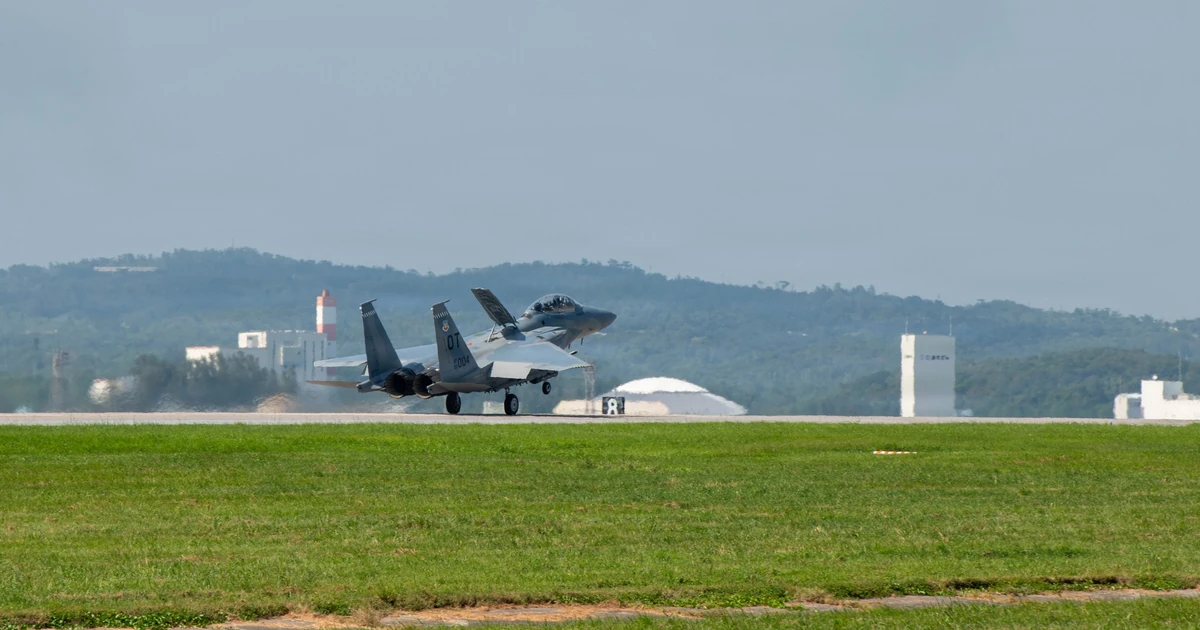
Featured image: An F-15EX Eagle II lands at Kadena Air Base, Japan, July 8, 2026. U.S. Air Force photo by Senior Airman Amy Kelley via DVIDS; public domain. The image is contextual and does not depict a Lot 7 aircraft.