 AFA Connect
What DSP’s retirement changes for U.S. missile warning
The Space Force retired the Defense Support Program after more than 55 years. Here is what the handoff means for U.S. missile warning and Next-Gen OPIR.
By Joy Glip ·
Original AFA Connect reporting. Facts are attributed to the public records and reporting listed below. Report a factual error.
Sources and records
- Space Force decommissions Defense Support Program constellation after 55 years — U.S. Space Force
- Space Force retires Cold War-era missile-warning constellation after final maneuver exercise — SpaceNews
- US military ends long-running program to spot nuclear missile launches — Ars Technica
- Space Force Sunsets Last 1970s-Era Missile Warning Satellites — Air & Space Forces Magazine
- STS-44 DSP satellite and IUS during preflight processing at Cape Canaveral — NASA
Image: NASA Johnson Space Center archival photograph S91-50773
The U.S. Space Force has closed the book on the Defense Support Program, ending a missile-warning mission that began in 1970 and lasted more than 55 years. The retirement matters less because an old satellite family disappeared than because it ends one legacy layer while the service relies on SBIRS and prepares to field Next-Gen OPIR.
The service announced the decommissioning in its official release. Ars Technica reported that the retirement followed a final maneuver exercise and that the last two operational spacecraft subsequently raised their orbits by several hundred kilometers, a pattern associated with moving retired geosynchronous satellites into disposal orbits.
A Cold War warning layer becomes history
DSP began with a November 1970 launch into geosynchronous orbit. Its infrared sensors were built to detect the heat signatures of missile launches, giving national leaders and military commanders warning that could not depend on ground-based observation alone. That role made the constellation part of the architecture supporting nuclear deterrence during the Cold War.
The mission later broadened in practice. Ars reported that DSP also detected Iraqi Scud launches, showing how a system designed around strategic warning could provide operational warning during conventional conflict. The spacecraft evolved as well: the earliest versions carried roughly 2,000 infrared detectors and weighed about one metric ton, while later satellites carried more than 6,000 detectors and weighed about 2.5 metric tons.
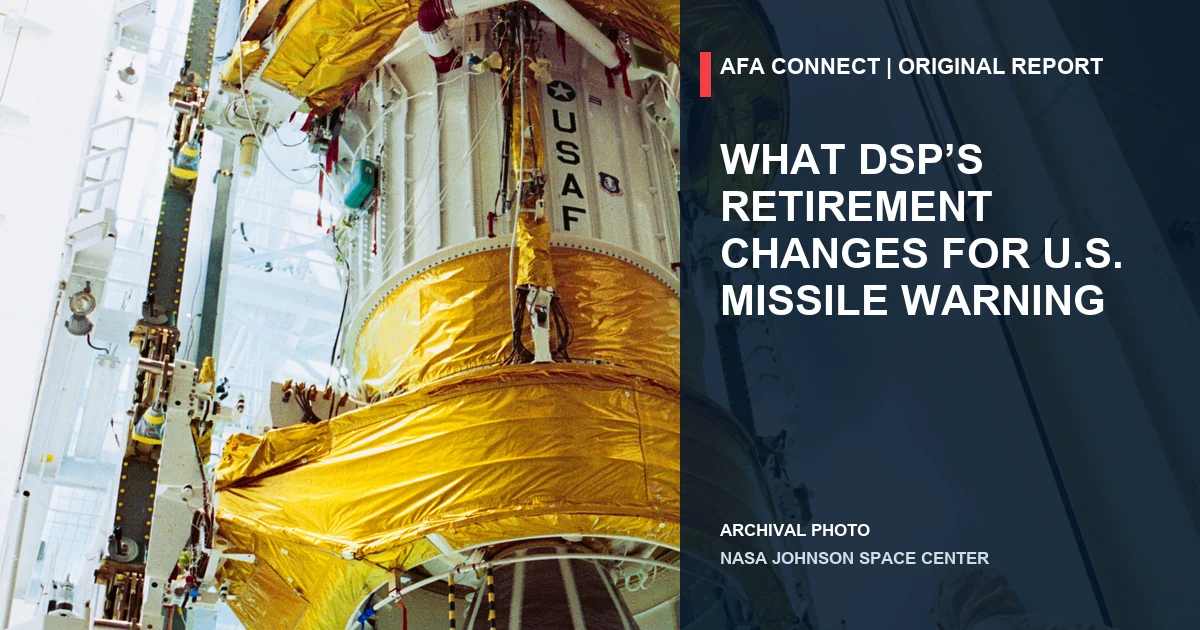
The archival NASA image used with this report comes from 1991 preflight processing for Space Shuttle mission STS-44. NASA's full record identifies a DSP spacecraft and its Inertial Upper Stage; this 1200-by-630 crop centers on the Inertial Upper Stage and adjoining adapter hardware inside the processing facility. NASA says the full scene shows the hardware being transferred into a payload canister transporter at Cape Canaveral for shipment to Kennedy Space Center's Launch Pad 39A. It is historical context, not an image of the final satellites retired in 2026.
Retirement is a handoff, not the end of missile warning
DSP's departure does not leave the United States without space-based infrared warning. The Space Based Infrared System, or SBIRS, began launching in 2011 and brought more capable sensors into the mission. Next-Generation Overhead Persistent Infrared, usually shortened to Next-Gen OPIR, is the follow-on modernization effort now in development.
That distinction is important. A program retirement date does not by itself measure whether warning coverage, data transport, processing, command relationships and backup pathways are resilient. The operational question is whether the full chain—from detecting an infrared event to delivering trusted warning to the right users—continues to work under stress.
DSP's longevity also illustrates a recurring acquisition lesson: strategic satellites often outlive the technology eras that produced them. The last spacecraft launched in 2007, decades after the program’s first launch in 1970. Long service lives can preserve useful capacity, yet they also force operators to sustain aging space and ground components while successors mature.
What changes for the Space Force
First, the service loses a legacy layer that had decades of operational history. Newer systems offer better sensing, but resilience depends on architecture, not age alone. Leaders will be judged on how well modern satellites, ground stations, networks and crews operate as one warning enterprise.
Second, the retirement makes the transition to Next-Gen OPIR more visible. Development schedules and launch milestones matter, but so do test quality, ground-segment readiness, data integration and the ability to maintain warning during a disruption. A satellite in orbit is not the same thing as an operational warning capability.
Third, DSP's final exercise provides a useful model for retiring strategic hardware. According to the independent reports, the final spacecraft took part in a maneuver event before disposal. That gave crews a last opportunity to plan and execute dynamic maneuvers with the legacy system while ending the mission in a controlled way.
The lasting significance
DSP's most important legacy is not simply that some satellites survived for decades. It is that persistent infrared warning became an expected military function. What began as a classified Cold War capability became part of how the United States detects launches, supports deterrence and protects deployed forces.
The program's retirement therefore closes one era without closing the mission. The transition now rests on SBIRS, the successful fielding of Next-Gen OPIR and the people and networks that turn sensor data into decisions. For the Space Force, that is the real measure of this transition: not whether DSP flew for 55 years, but whether the next architecture can deliver warning with equal persistence and greater resilience.