 AFA Connect
What Davis-Monthan’s Final A-10 Unit Closures Change
What the Davis-Monthan A-10 unit inactivations establish about pilot training—and what remains unknown about the wider fleet transition.
By Joy Glip ·
Original AFA Connect reporting. Facts are attributed to the public records and reporting listed below. Report a factual error.
Sources and records
- Final A-10 units inactivate at Davis-Monthan — Defense Visual Information Distribution Service / 355th Wing
- Davis-Monthan retires iconic A-10 Warthog aircraft in Tucson — KVOA
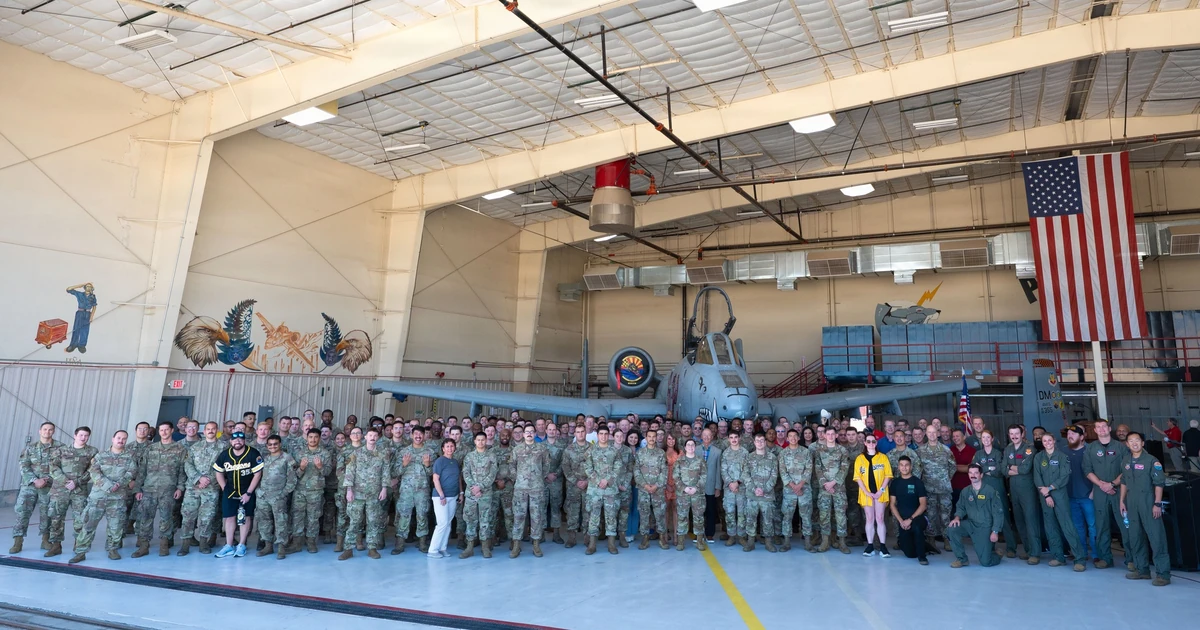
- A-10 Unit Inactivation Group Photo — Defense Visual Information Distribution Service
Image: U.S. Air Force photo by Jasmyne Bridgers-Matos via DVIDS (public domain)
Four A-10 organizations closed at Davis-Monthan Air Force Base on Sept. 18. The consequence is institutional as well as operational: the Air Force ended the local unit structure that oversaw formal A-10 pilot training, while decisions about the remaining aircraft and people extend beyond that ceremony.
The 355th Wing's official account identifies the inactivated organizations as the 355th Operations Group, 357th Fighter Squadron, 357th Fighter Generation Squadron and 355th Training Squadron. Tucson station KVOA independently reported the ceremony and the inactivation of the base's remaining A-10 units.
A unit closure is different from fleet retirement
The official account says the 355th Operations Group oversaw formal A-10 pilot initial qualification and requalification training. Closing that organization therefore ends a defined training responsibility at Davis-Monthan; it does not, by itself, establish when the last A-10 will leave service nationwide.
KVOA reports that base officials said the remaining A-10 aircraft would transfer to Moody Air Force Base in Georgia or to the Boneyard. That reporting describes different possible destinations for the aircraft. It should not be read as evidence that every remaining airframe was retired at the September ceremony.
The distinction matters when judging a force transition. Aircraft inventory, unit organization and the ability to train crews are related measures, but they are not interchangeable. A unit can be inactivated while aircraft and experienced personnel continue to have value elsewhere.
The immediate question is what happens to expertise
The ceremony account records a progression familiar to a training organization: learning as a wingman, teaching as an instructor and eventually handing over responsibility. Lt. Col. Ryan Rutter, identified by the Air Force as the final 357th Fighter Squadron commander, described that progression in his remarks.
Preserving expertise after an organizational closure requires more than preserving an aircraft. The questions to follow are where instruction will occur, how experience moves between units and how the remaining force maintains proficiency. The reviewed reports do not establish the complete arrangements, so a conclusion that the handoff is either complete or unsuccessful would be premature.
What the ceremony established—and what it did not
The official record confirms the four inactivations and says historical documents and memorabilia will go to the National Museum of the U.S. Air Force at Wright-Patterson Air Force Base. Those are concrete organizational and historical steps. They are not a published unit-by-unit plan for personnel assignments or future training responsibilities.
The useful next test is whether subsequent official records explain those responsibilities and transfers. Davis-Monthan's closure is a clear milestone in the A-10 transition. Treating it as a complete national retirement plan would claim more than the available evidence supports.