 AFA Connect
What CENTCOM’s Tanker Strikes Signal About Airpower
Air Force and Navy aircraft struck three Iranian oil carriers after attacks on U.S. warships. Here is what the shift means for joint airpower.
By Joy Glip ·
Original AFA Connect reporting. Facts are attributed to the public records and reporting listed below. Report a factual error.
Sources and records
- CENTCOM Destroys 3 IRGC Oil Tankers After Iran Targets 2 U.S. Navy Warships — U.S. Central Command via DVIDS
- US Fighters, Drones Strike 3 Iranian Oil Tankers After Iran Fires on Navy Ships — Air & Space Forces Magazine
- CENTCOM Destroys 3 IRGC Oil Tankers After Iran Targets 2 U.S. Navy Warships (video) — U.S. Central Command via DVIDS
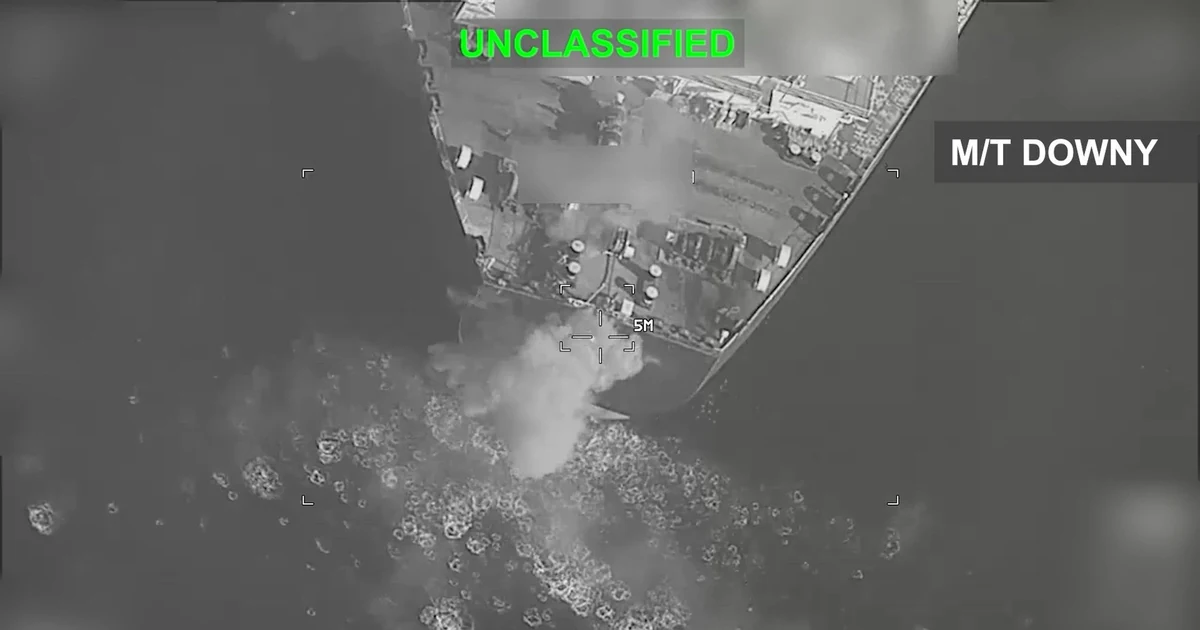
Image: A declassified CENTCOM video frame identifies M/T Downy during the Sept. 5, 2026, strike sequence. U.S. Central Command video via DVIDS
U.S. Central Command’s strikes on three Iranian oil carriers matter beyond the loss of three ships. They show American airpower being used against assets CENTCOM says help finance Iran’s Islamic Revolutionary Guard Corps, not only against the missiles, radars or launch systems more commonly associated with immediate force protection.
CENTCOM said its forces struck the carriers on Sept. 5 after the IRGC launched ballistic missiles toward a U.S. aircraft carrier and a guided-missile destroyer. According to the command’s official release, both warships evaded the attacks and no American personnel were harmed.
The command said it permanently disabled M/T Downy off Kharg Island and M/T Stark 1 near Jask. It said American forces destroyed the unladen M/T Kylo, also known as Noxen, in the Gulf of Oman after directing the crew to abandon ship. Those are CENTCOM’s descriptions; AFAConnect has not independently verified the battle-damage assessment or the crew’s ultimate condition.
The Air Force connection is operational, not incidental
The official CENTCOM release did not identify aircraft, weapons, units, launch locations or routes. Air & Space Forces Magazine reported, citing U.S. officials, that Air Force and Navy aircraft conducted the attacks with a mix of fighters and drones.
That attribution makes this more than a maritime story. It is an example of joint airpower answering a threat to naval forces while imposing costs away from the attacking missiles themselves. The preserved public record does not support naming specific aircraft models, weapons or units, so AFAConnect is not doing so.
The distinction is important. A strike on a launcher is primarily about stopping or degrading an immediate military threat. A strike on a revenue-generating carrier is designed to create a different kind of cost. CENTCOM described the three vessels as part of a multibillion-dollar network that funds the IRGC and regional proxies. Whether that characterization or the announced damage produces a measurable change in Iranian behavior remains unresolved.
A broader target set brings broader consequences
Airpower gives commanders reach, speed and the ability to combine surveillance and attack across large maritime areas. Those strengths also make target selection strategically consequential. Moving from an attacking weapon system to a commercial-form vessel alleged to support an adversary’s revenue network expands the economic and political stakes of a military response.
Air & Space Forces Magazine characterized the tanker attacks as part of a new administration effort to impose higher economic costs. It also reported Iran’s foreign ministry called the strikes a war crime and that the IRGC threatened reciprocal action. Those are attributed positions from the parties to the conflict, not independently established conclusions.
For Air Force leaders, the immediate lesson is not about one platform. It is about the demand created when air assets must support joint force protection, maintain surveillance over dispersed maritime traffic, preserve command-and-control links and hold time-sensitive targets at risk. A single successful strike sequence does not reveal the sustainability of that burden or the inventory cost behind it.
What the public evidence establishes
The official DVIDS video record identifies the 44-second release as U.S. Central Command footage from Sept. 5. It lists Video ID 1021952, VIRIN 260905-D-D0477-1016 and filename DOD_111954730. The frame used here is from that exact official asset and carries its original “UNCLASSIFIED” and “M/T DOWNY” labels.
The available evidence establishes that CENTCOM announced the three strikes, that the action followed attempted attacks on two U.S. warships, and that a reputable Air Force-focused publication reported Air Force and Navy participation based on U.S. officials. It does not establish the aircraft models, munitions, unit identities, independent damage assessment, crew outcome or the next step in the campaign.
That boundary is central to understanding the event. The operational result described by CENTCOM is clear. The strategic result is not. If economic infrastructure becomes a recurring target category, the Air Force and the joint force may face a longer, more resource-intensive mission—and a larger escalation problem—than any one strike video can show.
Have a correction or additional primary-source documentation? Contact AFAConnect.