 AFA Connect
What the B-21 factory expansion changes—and what it doesn’t
Northrop Grumman is adding about one million square feet to B-21 final assembly. Here is what the capacity increase changes—and what still depends on testing.
By Joy Glip ·
Original AFA Connect reporting. Facts are attributed to the public records and reporting listed below. Report a factual error.
Sources and records
- Air Force breaks ground on B-21 production expansion — Defense Visual Information Distribution Service / U.S. Air Force
- U.S. Air Force announces arrival of second B-21 test aircraft at Edwards AFB — Defense Visual Information Distribution Service / U.S. Air Force
- Northrop Grumman Accelerating B-21 Raider Production — Northrop Grumman
- B-21 Testing, Manufacturing Ramp Up: ‘We’re Moving Fast’ — Air & Space Forces Magazine
- Air Force Reaches Deal with Northrop to Boost B-21 Production Starting in 2027 — Air & Space Forces Magazine
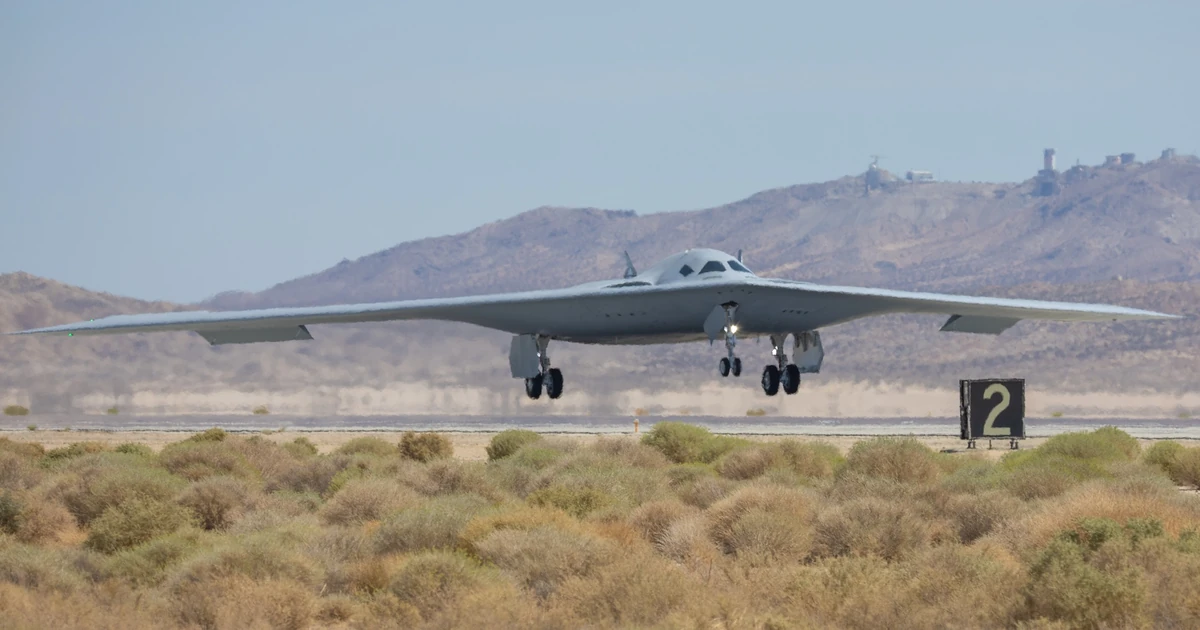
Image: U.S. Air Force photo by Todd Schannuth via DVIDS
Northrop Grumman and the U.S. Air Force have broken ground on a major expansion of B-21 Raider final assembly in Palmdale, California. The new construction is expected to add about one million square feet and increase production capacity by roughly 25 percent, according to Air & Space Forces Magazine.
Those numbers are consequential. They show the industrial base is being enlarged for a higher production tempo. But capacity is not the same thing as delivered aircraft, and delivered aircraft are not the same thing as combat-ready squadrons. The expansion is intended to add capacity at final assembly; it does not by itself resolve every constraint between factory construction and combat-ready squadrons.
Image: A B-21 Raider test aircraft lands at Edwards Air Force Base, California, during 2025 flight testing. U.S. Air Force photo by Todd Schannuth via DVIDS.
What one million square feet actually signals
A larger final-assembly footprint can support more work positions, equipment and concurrent aircraft flow. In a February 2026 company announcement, Northrop Grumman said it was investing in manufacturing technology and capacity across its facilities and increasing B-21 production rates. The later Palmdale groundbreaking provides a concrete example of that broader production push.
The most defensible conclusion is therefore narrow but important: the company and the Air Force are investing in physical capacity before higher factory output can be realized. That is an industrial decision with long lead times. Buildings, tooling, cleared labor and supplier capacity have to be available before they can support faster output.
It is not evidence that the program has already achieved a 25 percent increase in completed bombers. The announced figure describes capacity expected from the expanded facility. Construction must be finished, staffed and integrated into production before that capacity can translate into aircraft.
Production is only one clock
The Raider program is running at least three clocks at once: construction and manufacturing, flight testing, and operational fielding. They influence one another, but they are not interchangeable milestones.
Air & Space Forces reported that two B-21s are publicly known to be in testing at Edwards Air Force Base and that the Air Force is using an integrated test approach that brings developmental and operational testers together earlier. That can expose problems and operator needs sooner. It cannot remove the need to complete testing, correct deficiencies, train maintainers and aircrews, establish support systems and demonstrate usable mission capability.
The Air Force has planned for the B-21 to enter the operational fleet in 2027. That date remains a fielding objective, not proof that every aircraft moving through an expanded factory will immediately become combat-ready. Production rate, test findings and the pace of unit conversion will determine how quickly factory output becomes deployable capacity.
The fleet-size question remains open
The program of record calls for at least 100 B-21s, but senior leaders have publicly discussed the possibility of a larger fleet. The factory expansion makes a higher eventual rate more plausible; it does not constitute an Air Force decision to buy more aircraft.
That distinction matters because capacity and procurement authority answer different questions. A contractor can prepare to build faster, while the government still must budget for and order aircraft. Congress then decides what to authorize and appropriate. A bigger facility protects options. It does not exercise them.
The Air Force and Northrop Grumman also announced a $4.5 billion production agreement in February 2026 to increase B-21 production by 25 percent. The new construction is consistent with that direction, but the publicly available record still does not establish the exact annual production rate, the number of aircraft covered by future lots or a final fleet larger than 100.
The harder measure is usable bomber capacity
The B-21 is central to replacing the B-1B and B-2A while sustaining the long-range strike mission. That makes the health of the production system strategically important. A line that cannot grow would constrain every later decision about bomber force size and transition timing.
Still, the measure that matters to commanders is not square footage. It is the number of mission-capable aircraft, trained crews and maintainers, available weapons and functioning support systems that can generate sorties when required. Factory expansion supports that outcome without guaranteeing it.
The Palmdale groundbreaking is therefore best read as an enabling milestone. It shows that the physical production system is being enlarged before the B-21 enters operational service. The next tests are whether construction turns into sustained manufacturing flow, whether flight testing supports the fielding schedule, and whether future budgets convert the new capacity into enough combat-ready bombers to meet the Air Force’s long-range strike requirements.