 AFA Connect
TRICARE’s 2027 blood-transfusion payment test: a family guide
A scheduled TRICARE blood-transfusion payment demonstration raises practical questions about cost sharing, eligibility and local ambulance capabilities.
By Joy Glip ·
Original AFA Connect reporting. Facts are attributed to the public records and reporting listed below. Report a factual error.
Sources and records
- TRICARE Demonstration Project for Prehospital Blood Transfusions — Defense Health Agency / Federal Register
- TRICARE Reimbursement Manual, Chapter 1, Section 14: Ambulance Services — Defense Health Agency
- Using Other Health Insurance — TRICARE
- Operation Blood Rain archival photo record — DVIDS
Image: Courtesy photo via DVIDS
For eligible Airmen, Guardians and their families, a TRICARE demonstration scheduled to begin January 1, 2027, is worth understanding before treating it as a promise of free blood transfusions or a guarantee that a local ambulance will carry blood.
The Defense Health Agency’s July 6 Federal Register notice describes a five-year test of separate payments for blood administered before a patient reaches the hospital. It is a change to ambulance-provider reimbursement, with beneficiary cost-sharing implications—not a finding that the service is already available everywhere.
What changes from the existing payment rule
The TRICARE Reimbursement Manual’s ambulance section, section 3.2.2, describes a base rate plus mileage that covers associated items and services without separate payment for those items and services.
The demonstration adds a separate blood-product payment and a separate administration payment for qualifying transports. That distinction matters: paying a provider differently does not by itself establish what a particular patient will owe, or whether a particular ambulance offers the service.
The notice limits the test to medically necessary blood administered during medically necessary advanced life support level 2, specialty-care or air transport. Ground and air ambulance companies must be TRICARE-authorized and licensed to administer prehospital blood.
It is not a blanket no-cost benefit
Section 9 says applicable cost sharing, deductibles and copayments remain in place. It specifically says TRICARE For Life beneficiaries will have a 25% copay on the TRICARE-allowed add-on payment. The notice also warns that some beneficiaries may face higher out-of-pocket costs.
That percentage is not a quote for an individual ambulance bill. This report does not calculate a plan-specific charge or resolve how the blood-product payment and separately payable administration service will be treated on a particular claim.
Eligibility is limited to the plans and circumstances named in the notice. Exclusions include the US Family Health Plan, the Competitive Plans Demonstration or future iterations, claims outside the 50 United States and territories where the Ambulance Fee Schedule does not apply, and specified other-health-insurance situations. Being an Airman, Guardian, family member or retiree does not by itself establish eligibility.
A Medicare coordination question remains
The notice expressly includes TRICARE For Life beneficiaries, including those enrolled in Medicare Advantage. It also excludes beneficiaries with other health insurance when TRICARE is not the primary payer.
TRICARE’s general other-health-insurance guidance calls Medicare a federal entitlement and says TRICARE pays after Medicare and other health insurance. These records do not explain the demonstration’s operational boundary for mixed coverage. They do not support a blanket claim that every Medicare-primary case is excluded, nor a definitive promise of payment for an individual claim.
The July notice says additional implementation details will be provided in the TRICARE Manuals. The sources reviewed here support an explanation of the scheduled policy, not definitive claim-processing instructions.
What this does not tell you about your community
DHA plans to evaluate access and network adequacy. Those are questions the demonstration is intended to test, not proof that every community already has an ambulance carrying blood.
The practical distinction is between a scheduled reimbursement policy, a provider’s authorization and capabilities, and an individual beneficiary’s coverage. The notice alone cannot establish all three for a particular emergency.
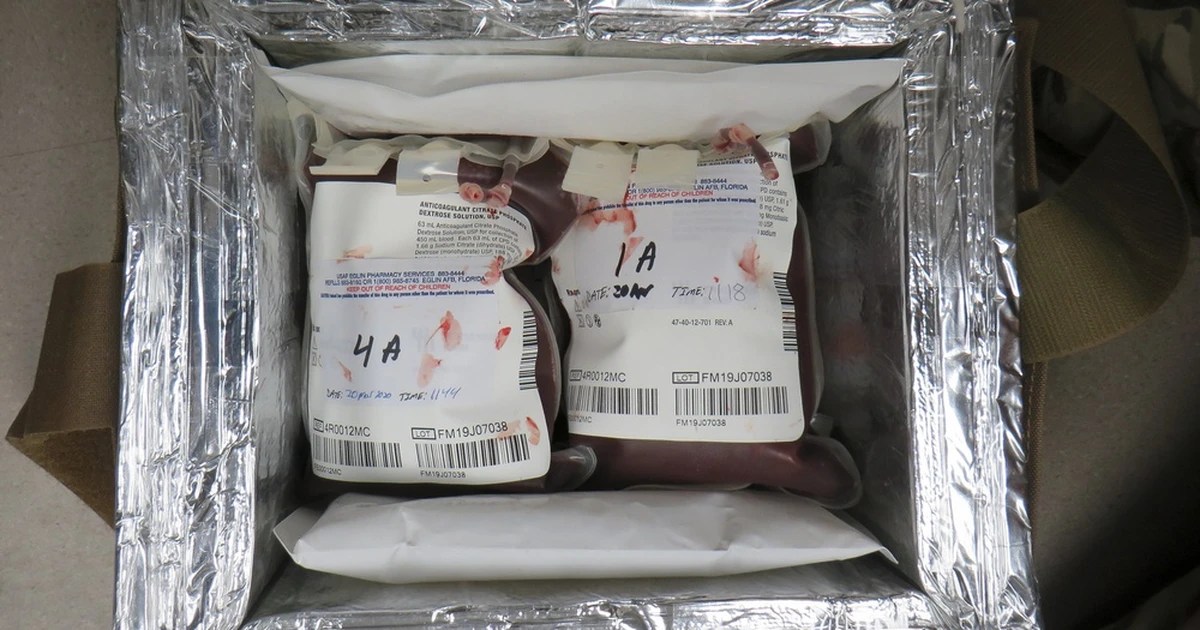
Archival photograph: bags of blood packed for the Operation Blood Rain study at Eglin Air Force Base, Florida, April 20, 2020. This is not an ambulance participating in the 2027 TRICARE demonstration. Courtesy photo via DVIDS. The appearance of U.S. Department of War (DoW) visual information does not imply or constitute DoW endorsement.
Questions or corrections: Contact AFA Connect.