 AFA Connect
Japan and U.S. Agree on AMRAAM Assembly in Japan, With Output Details Open
Japan and the U.S. agreed to establish AMRAAM final assembly in Japan. The announcement leaves the facility’s operating date, output and deliveries open.
By Joy Glip ·
Original AFA Connect reporting. Facts are attributed to the public records and reporting listed below. Report a factual error.
Sources and records
- Japan-U.S. Defense Ministerial Meeting (Summary) — Japan Ministry of Defense
- Fourth Japan-U.S. Defense Industrial Cooperation, Acquisition, and Sustainment Plenary — Japan Ministry of Defense
- US and Japan to set up a Japanese facility for joint missile production — Associated Press
- Combat Generation Exercise Reinforces Trilateral Partnerships, photo 8416608 — DVIDS / U.S. Air Force
Image: U.S. Air Force photo by Staff Sgt. Peter Reft via DVIDS
Japan and the United States have agreed to establish an AMRAAM Final Assembly and Check-Out facility in Japan, according to Japan’s Defense Ministry’s account of an October 28 meeting between Defense Minister Shinjiro Koizumi and U.S. defense chief Pete Hegseth. The announcement moves a proposal discussed in April to an agreement, but gives no date for an operating facility or missile deliveries.
That distinction is the central story. In April, the two governments had agreed to discuss whether Japanese final assembly was possible. The October statement says they agreed to establish it. Neither statement demonstrates that the facility is operating or that additional missiles are reaching military units.
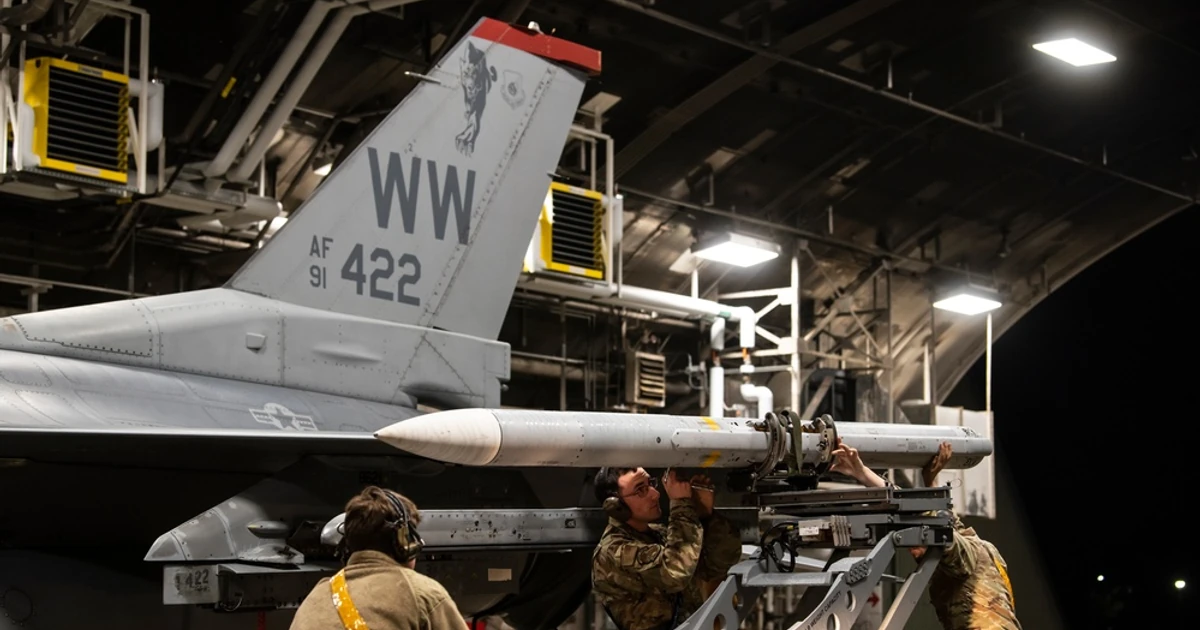
Archival context: U.S. Air Force personnel secure an AIM-120 missile on an F-16 at Misawa Air Base, Japan, May 6, 2024. This photograph does not show the planned assembly facility. U.S. Air Force photo by Staff Sgt. Peter Reft via DVIDS. The appearance of U.S. Department of War (DoW) visual information does not imply or constitute DoW endorsement.
What changed between April and October
The April 14 defense-industrial cooperation statement separated two AMRAAM initiatives. It identified circuit-card assembly as part of the scope of co-production, following a feasibility study, while leaving Final Assembly and Check-Out in Japan as a possibility for further discussion.
The October 28 ministerial account uses firmer language: the ministers “agreed to establish an AMRAAM FACO in Japan.” It places the decision within Operation Supercharge, a bilateral defense-equipment and technology cooperation initiative.
Including one component in co-production discussions and agreeing to establish final assembly are different milestones. The newer announcement moves the latter beyond the exploratory wording in April. It does not supply the implementation details needed to judge when an assembly facility could contribute usable missiles.
The Associated Press independently reported the agreement following Koizumi’s news conference in Cebu, Philippines. AP reported that Koizumi described the missiles as essential for the F-35, but did not provide other details of the agreement. That connects the announcement to an air-combat capability without establishing a delivery commitment to a particular service or unit.
An agreement is not a production rate
For readers assessing the capacity implications, the next questions concern component supply, production output, qualification and delivery. These are questions to test as implementation becomes public, not announced facts about this facility.
An additional assembly location would not by itself demonstrate additional delivered missiles. Assessing that benefit would require evidence that components are available, that completed missiles satisfy applicable requirements, and that output reaches customers. The reviewed October release gives no AMRAAM production rate, operational date or delivery schedule.
Nor does its AMRAAM announcement identify a facility location within Japan, an operator or a contractor workshare. The April statement names Mitsubishi Electric and Raytheon in connection with the feasibility study. That historical involvement is not evidence of an October award to build or operate the facility.
A separate missile initiative also requires care. The April release discusses approximately fourfold production growth for SM-3 Block IIA, and the October account addresses technical-information sharing for that program. Neither statement assigns that production figure to AMRAAM.
What to watch next
The agreement provides a clearer political commitment to Japanese AMRAAM final assembly than the April discussion did. Its practical contribution remains a question of implementation. Future announcements about site selection, responsibilities, qualification, output and deliveries would help establish what the decision changes for available missile inventories.
Until those details emerge, the defensible conclusion is narrower: the allies have agreed to establish a facility; they have not announced that it is producing missiles.