 AFA Connect
Gen. Douglas Schiess Takes Over a Space Force Entering Its Growth Test
The third Chief of Space Operations inherits a service preparing to expand sharply. His test is turning more people and money into credible combat power without losing focus.
By Joy Glip ·
Original AFA Connect reporting. Facts are attributed to the public records and reporting listed below. Report a factual error.
Sources and records
- Schiess Sworn in as New Space Force Chief: ‘We Must Grow with Intention’ — Air & Space Forces Magazine
- Senate confirms new Chief of Space Operations — Military Times
- Schiess takes command of Space Force as the service prepares for expansion — SpaceNews
- Schiess installed as Space Force’s highest-ranking officer — Stars and Stripes
- Schiess Takes Charge of U.S. Space Force — SpacePolicyOnline.com
- CSO Promotes Gen. Schiess — U.S. Air Force via DVIDS
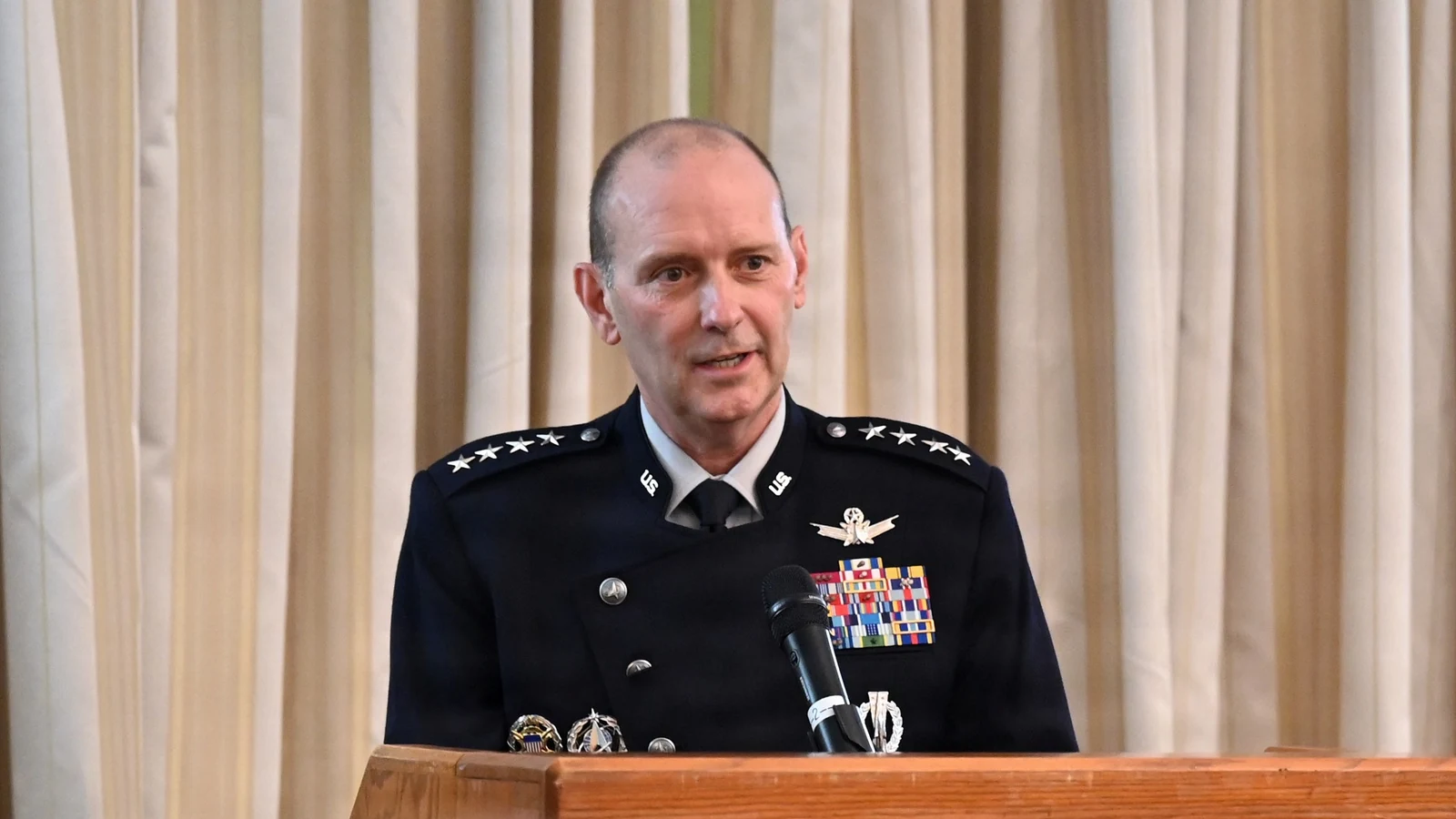
Image: Gen. Douglas Schiess addresses the audience during his promotion ceremony at Joint Base Andrews, Maryland, on Sept. 3, 2026. U.S. Air Force photo by Andy Morataya
Gen. Douglas A. Schiess is now responsible for shaping what the Space Force becomes next. He assumed leadership Sept. 3 at Joint Base Andrews, Maryland, becoming only the third Chief of Space Operations since the service was established in 2019.
The succession is more than a change at the top. Schiess takes over while the Space Force is preparing for a major increase in people, missions and spending—and while military operations depend ever more heavily on space-based warning, communications, navigation and targeting. The central question is no longer whether the young service will grow. It is whether that growth can become durable combat power quickly enough and coherently enough to meet the demand.
Air & Space Forces Magazine, SpaceNews and SpacePolicyOnline.com independently reported the Sept. 3 transfer of responsibility from Gen. B. Chance Saltzman to Schiess. Air Force Secretary Troy Meink administered the oath, and Schiess received his fourth star the same day.
Why this office matters
The Chief of Space Operations is the Space Force’s senior uniformed officer and a member of the Joint Chiefs of Staff. That gives Schiess a central role in advising national leadership, developing the service’s force, presenting its requirements and ensuring Guardians are organized, trained and equipped for joint operations.
There is an important limit to that authority. A service chief does not personally command military operations. As SpacePolicyOnline.com explained, the ceremony is called a change of responsibility because the CSO builds and prepares the force, while operational command runs through the nation’s combatant commands. That distinction helps define Schiess’s real test: he must translate strategic priorities and congressional resources into forces that combatant commanders can actually employ.
That task fits his recent experience. Before becoming CSO, Schiess served as deputy chief of space operations for operations, overseeing global operations, readiness, sustainment and training. He previously led U.S. Space Forces–Space, the service component supporting U.S. Space Command, and held assignments involving missile warning, launch, GPS, satellite communications, command and control, and joint operations.
Military Times reported that Schiess told senators he would strengthen the connection between force design, acquisition programs and combatant-command requirements. That linkage may be the most practical measure of his tenure: whether new systems arrive because operators need them, on timelines that matter, with trained Guardians ready to use them.
Growth is an execution problem
Schiess inherits a service moving from institutional startup toward large-scale expansion. Air & Space Forces Magazine reported that the uniformed force grew from roughly 8,000 to 10,000 Guardians during Saltzman’s four years and is on a path toward 20,000 over the next five years. It also reported a $71 billion fiscal 2027 budget request—more than twice the prior year’s request. Stars and Stripes placed the current uniformed and civilian workforce above 15,000 and reported plans to hire 2,000 civilians.
Those requests are not the same as enacted funding or completed growth. Congress will decide what resources are approved, and the service will still have to recruit, absorb, train and retain the workforce. Rapid expansion also creates less visible demands: instructors, test capacity, facilities, sustainment, security, doctrine and command relationships must mature alongside headline weapons programs.
Schiess’s first message recognized that risk. He called for the Space Force to “grow with intention” and tied manpower growth to acquisition, fielding, operations, industry partnerships and the way Guardians fight. That is a more demanding standard than increasing end strength. It means every added billet and program should solve a defined operational problem rather than simply enlarge the organization.
Three tests for the new chief
First, readiness must keep pace with expansion. A larger service is not automatically a more capable one. Training pipelines, unit certification, resilient ground infrastructure and realistic exercises must grow at the same rate as missions and personnel. Schiess has pledged to keep Guardians ready and capabilities resilient; public evidence of that progress should include deployable units and usable capacity, not only plans and organizational charts.
Second, acquisition must connect force design to operators. Schiess’s confirmation testimony emphasized the relationship among force design, programs and combatant-command needs. The decisive issue is whether that relationship shortens the distance between a documented threat, an approved requirement and a fielded capability. Large budgets can buy more hardware, but they do not by themselves produce integration, training or operational availability.
Third, the Space Force must remain a joint force. Space effects support every military service, and demand for them spans missile warning, protected communications, navigation, intelligence support and counterspace missions. The CSO’s influence will depend on how clearly Schiess turns those demands into priorities—and how effectively the service integrates with U.S. Space Command and other combatant commands without duplicating their operational authority.
Continuity, but not autopilot
Schiess’s opening emphasis on threats, warfighting and deterrence continues themes Saltzman established. Continuity can be valuable for a service that is still building its institutions. It should not be mistaken for an automatic path to success.
The environment is changing faster than a normal military bureaucracy prefers. Potential adversaries are advancing systems intended to interfere with satellites and the ground networks that support them. At the same time, the United States is asking the Space Force for more effects across more operations. Schiess therefore inherits two pressures at once: move faster, and build processes strong enough to endure.
His appointment is consequential precisely because the next stage will be harder to measure than the Space Force’s creation. Establishing a branch, transferring personnel and naming organizations are visible milestones. Building a combat-credible service at greater scale requires years of disciplined choices about people, training, architecture, acquisition and joint integration.
Schiess is now the officer accountable for making those choices cohere. His stated goal—intentional growth in service of deterrence—sets the right test. The evidence will be whether the force becomes not merely larger, but more ready, more resilient and more useful to the commanders who depend on it.
Image note: The official DVIDS record identifies the photograph as U.S. Air Force visual information by Andy Morataya and marks it public domain. Its appearance here does not imply Department of War endorsement.