 AFA Connect
Dan Driscoll’s Exit Puts the Army’s Transformation Drive at a Crossroads
Driscoll gave no public reason for leaving. The immediate test is whether his acquisition and drone reforms survive a leadership gap.
By Joy Glip ·
Original AFA Connect reporting. Facts are attributed to the public records and reporting listed below. Report a factual error.
Sources and records
- Dan Driscoll steps down as US Army secretary after 18 months — The Associated Press
- Army Secretary Dan Driscoll resigns after clashes with Defense Secretary Hegseth — NPR
- Army Secretary Dan Driscoll resigns on short notice amid reported friction with Hegseth — Military Times
- Secretary of the Army Driscoll announces FUZE — U.S. Army via DVIDS
- Sec Army Speaks at the Pennsylvania Defense & Innovation Summit — U.S. Army via DVIDS
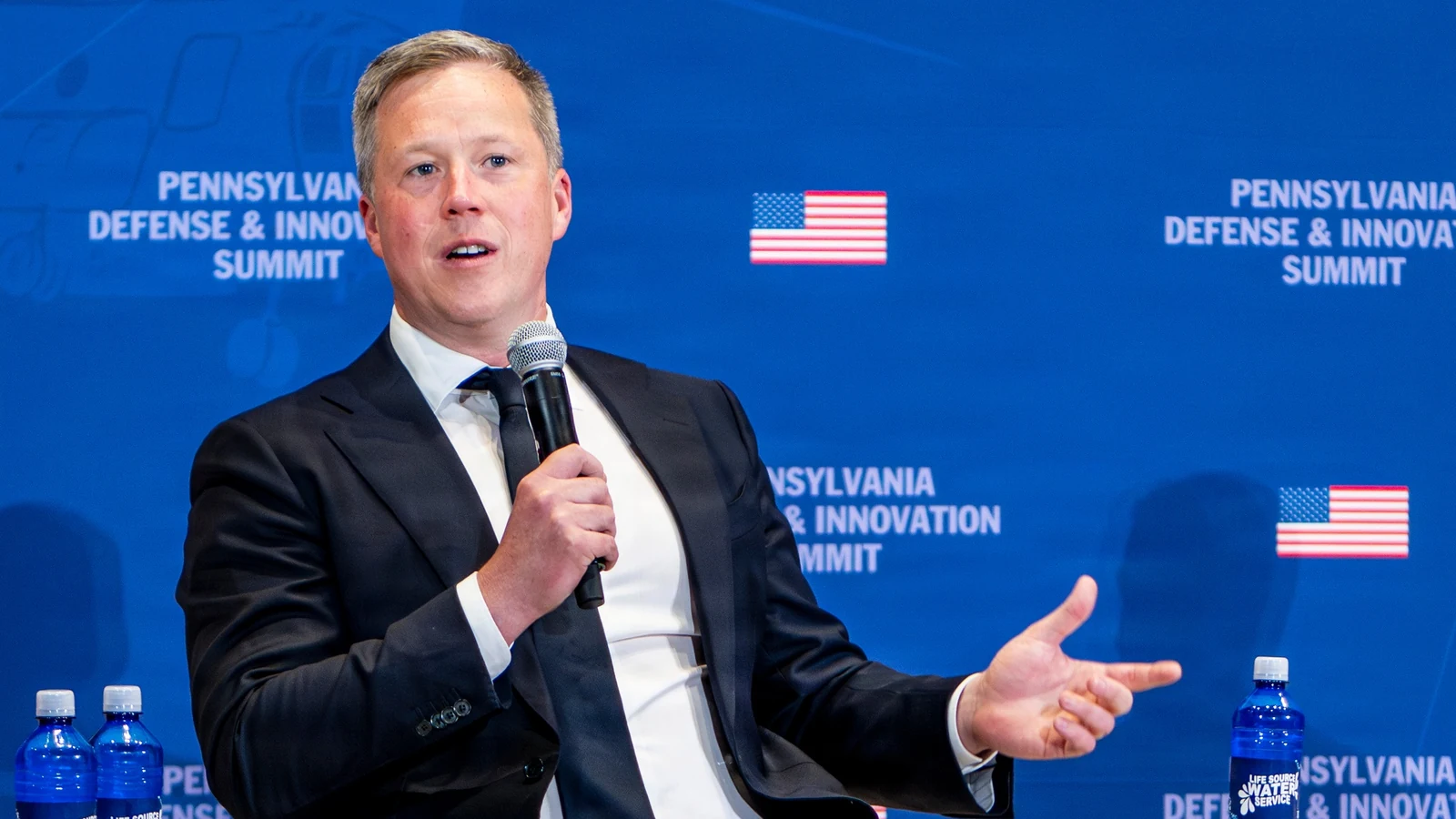
Image: Dan Driscoll speaks at the Pennsylvania Defense and Innovation Summit in Carlisle, Pennsylvania, on July 15, 2026. U.S. Army photo by Staff Sgt. Amanda McLean.
Dan Driscoll’s departure as secretary of the Army is official. The reason for it is not. That distinction is essential as the Army confronts an abrupt civilian-leadership change while major acquisition, drone and force-modernization efforts are still in motion.
Driscoll said Wednesday, Sept. 2, was his last full day in the job, according to The Associated Press. The White House had confirmed his departure two days earlier. AP reported that Driscoll spoke with President Donald Trump about the state of the Army before submitting his resignation. Military Times reported that the resignation was effective Sept. 3.
Neither the public White House statement quoted by AP nor Driscoll’s farewell message supplied a reason. In that message, Driscoll called the assignment the honor of a lifetime, praised soldiers, families and the Army’s civilian workforce, and credited Defense Secretary Pete Hegseth with supporting the progress made during his tenure.
What is established—and what remains reported
Multiple outlets, including NPR, AP and Military Times, described friction between Driscoll and Hegseth. Their reporting points to disputes over senior Army leadership and the direction of drone modernization. Those accounts provide important context, but they are not an officially stated cause of the resignation.
The responsible conclusion is therefore narrower than many headlines: Driscoll resigned after 18 months as the Army’s top civilian official; the White House confirmed the departure; he gave no public reason; and reported disagreements inside the Pentagon remain attributed reporting rather than a proven explanation.
Why the vacancy matters
The Army secretary does not command troops in the operational chain of command. The office instead carries civilian responsibility for the service’s organization, personnel, budget, acquisition and long-range planning. That makes continuity especially important when the Army is trying to change how it buys technology and equips units.
The timing also creates a two-part senior-leadership problem. Gen. Christopher LaNeve has served as acting Army chief of staff since Hegseth removed Gen. Randy George in April, AP reported. As of AP’s Sept. 2 update, it was not immediately clear who would perform the secretary’s duties after Driscoll’s departure. Acting officials can keep the institution operating, but a service navigating simultaneous civilian and uniformed transitions faces harder questions about priority, accountability and who has authority to make lasting tradeoffs.
The transformation agenda now faces a durability test
Driscoll made acquisition reform central to his tenure. An official Army record on DVIDS documents his September 2025 announcement of FUZE, described as a cradle-to-grave acquisition process modeled on the private-capital ecosystem. Military Times reported that the initiative was intended to move selected ideas from concept to prototype on a much faster timeline.
His agenda also included expanded drone and counter-drone capabilities, faster access to test ranges and a stronger military right-to-repair position. Those efforts were responses to a real institutional problem: commercial technology and battlefield adaptation can move faster than the traditional defense-acquisition system.
The central question is not whether every initiative carried Driscoll’s name. It is whether the reforms were embedded deeply enough in requirements, budgets, contracts and Army organizations to survive a change in sponsor. Programs with approved funding and written direction do not automatically disappear when a secretary leaves. But reforms that depend on personal intervention to overcome bureaucracy are more vulnerable when that official is gone.
Drone policy is an early test. AP reported that LaNeve ended a specialized drone effort in Europe that Driscoll had championed, prompting a bipartisan group of lawmakers to seek an explanation from the Army. That dispute predates the completed departure, but it shows why the succession question matters: modernization is not one program. It is a set of choices about who can experiment, how quickly successful ideas scale and which leaders are empowered to accept risk.
Why this is military-wide news
Driscoll’s resignation is an Army event, but its significance is broader than one service. Service secretaries translate presidential and defense-secretary priorities into budgets, personnel policy and acquisition decisions. An unexpected vacancy can test whether reforms belong to durable institutions or to individual leaders.
The departure does not by itself establish a crisis, prove a motive or dictate an outcome for the Air Force or Space Force. It does, however, add another senior transition inside the Pentagon and gives Congress a concrete reason to examine leadership continuity, confirmation timelines and whether fast-moving modernization programs retain clear civilian ownership.
What to watch next
- Acting leadership: who is formally designated to perform the secretary’s duties and what authority that official is given.
- A permanent nominee: the White House’s choice, the nominee’s modernization priorities and the pace of Senate consideration.
- Written program direction: whether FUZE, drone initiatives, right-to-repair policy and rapid testing remain visible in Army guidance and budget execution.
- Uniformed leadership: whether the administration nominates a permanent Army chief of staff and how civilian and military responsibilities are divided during the transition.
- Congressional oversight: whether lawmakers obtain answers on the drone-unit decision and connect that issue to the wider leadership change.
Driscoll’s exit is consequential not because every reported dispute can already be treated as fact, but because the Army must now demonstrate that its transformation effort can outlast the official most closely identified with pushing it forward.